
If you choose to define a backup policy, follow the steps below. Policies help standardize backup configurations across multiple devices or customers.
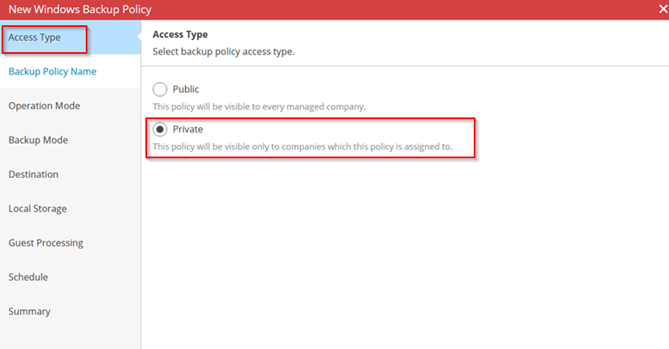
1. Access Type
When the policy creation window opens:
1.1. Set Access Type to Private.
1.2. Proceed to the next step.
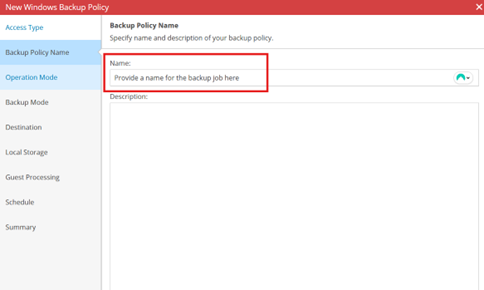
2. Backup Policy Name
Enter a descriptive and meaningful name for the policy. This helps easily identify the policy when applying it to future devices or customers.
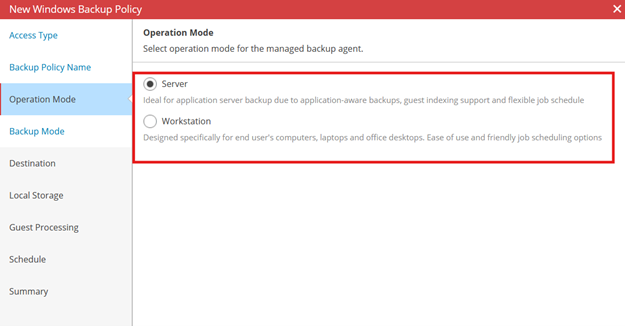
3. Operation Mode
Select the mode based on the type of device being protected:
3.1. Server
Recommended for servers. Supports advanced capabilities such as database backups and guest indexing.
3.2. Workstation
Suitable for desktops and laptops used in office environments.
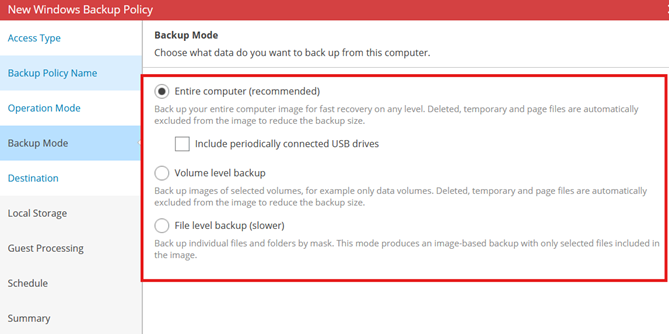
4. Backup Mode
Choose how data will be protected:
4.1. Entire Computer (Recommended)
Provides full system protection and allows complete recovery.
4.2. Volume‑Level Backup
Back up specific disk volumes only.
4.3. File‑Level Backup
Protects individual files. This method is slower and should only be used when necessary.
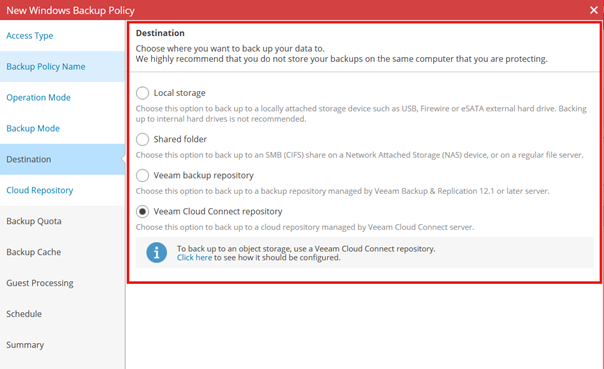
5. Destination
Select Cloud Connect Repository if backups will be stored on the service provider’s infrastructure.
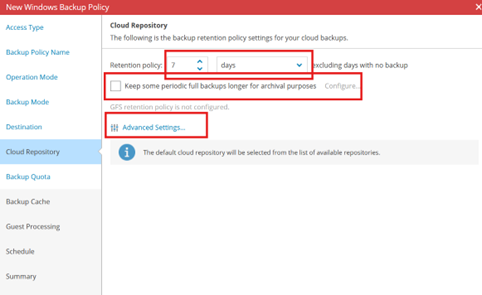
6. Cloud Repository Settings
6.1. Retention
Specify how many days backup data should be retained.
6.2. Archival Options
Enable Keep some periodic full backups longer for archival purposes for long‑term retention needs.
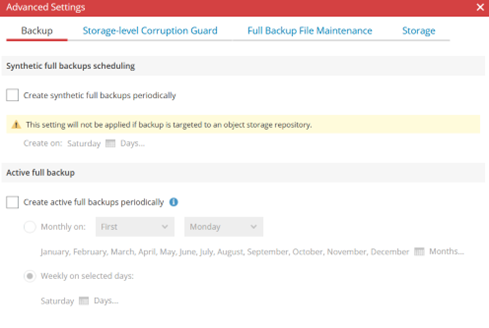
6.3. Advanced Settings
Configure full‑backup behavior as required:
6.3.1. Schedule backups during off‑peak hours to minimize load.
6.3.2. Active Full backups are recommended for efficiency.
6.3.3. Synthetic Full backups may take longer and are not typically required.
6.3.4. All other advanced options can remain at their default values.
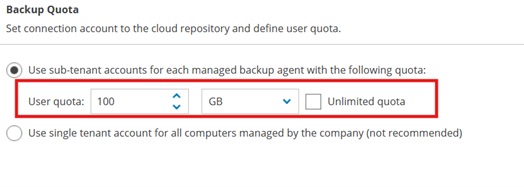
7. Backup Quota
Specify a quota limit for the policy or choose Unlimited if no restrictions are necessary.
8. Backup Cache (Optional)
This step can be skipped unless offline caching is required for roaming devices.
9. Guest Processing (Optional)
If the workload includes Microsoft Exchange, Microsoft SQL Server, Oracle and SharePoint you must enable Application‑aware processing to ensure transactional consistency, support log truncation, and enable reliable restores.
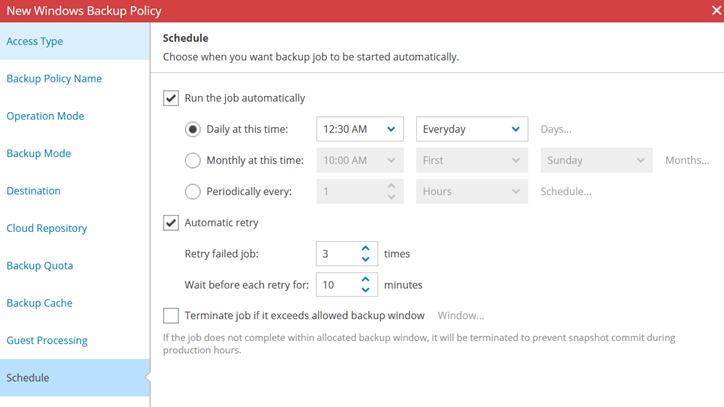
10. Schedule
In the final step, set how frequently the backup should run based on your requirements.
Best Practice Recommendations for Agent‑Based Backups
The following best practices are recommended for customers and resellers deploying agent‑based backups through Veeam Cloud Connect. These guidelines help ensure reliable recovery, consistent job performance, and long‑term data protection.
1. Use Full Machine (Entire Computer) Backups
For most environments, Entire Computer backups provide the highest level of protection.
1.1. Enables full system recovery after hardware failure, encryption/malware damage, corruption, or accidental deletion
1.2. Simplifies restore operations
1.3. Ensures all system states and configurations are captured
1.4. This method is strongly recommended as the default backup mode.
2. Prefer Active Full Backups
Configure backup jobs to use Active Full backups rather than relying exclusively on Synthetic Fulls. Why this matters:
2.1. Produces clean, independent restore points
2.2. Reduces reliance on long incremental chains
2.3. Minimizes risk of chain corruption
2.4. Improves restore reliability for long‑term retention
2.5. Schedule Active Fulls during off‑peak hours whenever possible.
3. Run an Active Full After Any Job Changes
Whenever any backup job setting is changed, run an Active Full backup immediately to apply the changes cleanly.
3.1. This includes changes to:
3.1.1. Backup mode (entire machine, volume level, file level)
3.1.2. Included or excluded volumes
3.1.3. Retention settings
3.1.4. Repository/target
3.1.5. Compression, encryption, or advanced options
3.1.6. GFS retention settings
3.1.7. Scheduling
3.2. Running an Active Full ensures the updated configuration takes effect without relying on legacy restore chains.
4. Enable GFS for Long‑Term Retention
For customers requiring extended retention, enable GFS (Grandfather–Father–Son).
4.1. Recommended Standard:
4.1.1. Daily: 7 days (lower‑priority workloads) or 14 days (high‑priority workloads)
4.1.2. Weekly: 4 weeklies
4.1.3. Monthly: 12 monthlies
4.1.4. Yearly: 5 yearlies
4.2. This retention model is designed to provide an optimal balance between short‑term recovery flexibility and long‑term archival requirements.
Retention policies should ultimately be aligned with your organisation’s specific operational, compliance, and regulatory needs.
For customised GFS retention planning or assistance, please contact Support.
5. Align Monthly GFS and Full Backup Schedules
To maintain a clean and predictable recovery chain:
5.1. Monthly GFS full backups must run on the same day as the Active Full backup.
5.2. This ensures that each monthly GFS point is a clean full backup, preventing inconsistencies and eliminating dependence on incremental chains.
6. Ensure Consistent Connectivity for On‑Prem Devices
Agent‑based backups depend on workstation/server connectivity to the gateway. To avoid failures:
6.1. Ensure devices can regularly reach Cloud Connect gateways
6.2. Confirm no firewalls or proxies block outbound traffic
6.3. Maintain reliable DNS resolution
6.4. Keep devices powered on during scheduled backup windows
6.5. Laptops should ideally back up while connected to a stable network (not in sleep mode).
7. Ensure Sufficient Bandwidth and Storage Performance
Backup success is influenced by:
7.1. Available bandwidth for offsite uploads
7.2. Local disk performance on the protected machine
7.3. Avoiding heavy workloads during backup windows
7.4. Where possible, schedule backups outside of peak production hours.
8. Keep the Agent and OS Updated
To prevent connectivity or performance issues:
8.1. Ensure Veeam agents are updated when available
8.2. Keep the operating system patched and stable
8.3. Reboot systems periodically, especially after OS or agent updates
9. Regularly Verify Backup Status
Customers should periodically:
9.1. Check the VSPC portal for warnings or errors
9.2. Confirm last successful backup times
9.3. Verify retention is meeting operational and compliance needs
9.4. A quick monthly review helps avoid unnoticed delays or failures.